
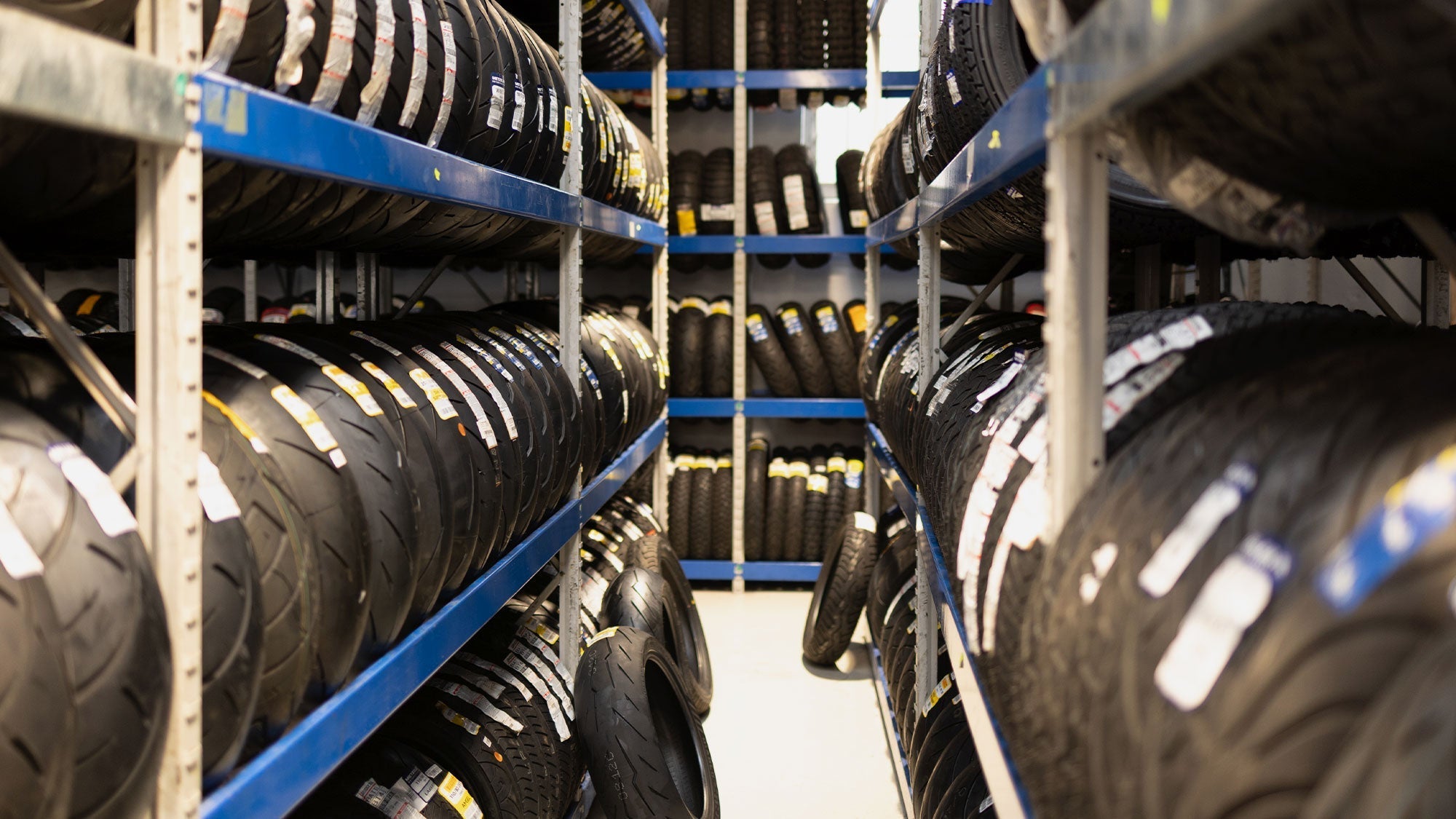
Choosing motorcycle tyres comes down to one question: where do you spend 80% of your riding time? Match the tyre type to that answer (commuting, touring, supersport, adventure or dirt) and you get more grip, more kilometres and fewer surprises than any single "best tyre" recommendation can offer. This guide matches each riding style to the right type of tyre, explains what that tyre is built to do, and names the tyres we rate in every category, from premium rubber to budget picks that punch well above their price.
In this article
- How do I know which type of motorcycle tyre I need?
- What are the best tyres for commuting and touring?
- What tyres should I run on an adventure bike?
- What are the best supersport tyres for the road?
- Which tyres should I choose for dirt riding?
- Why buy tyres in-store instead of online?
- Frequently asked questions
How do I know which type of motorcycle tyre I need?
Start with the sizes your bike is approved for: they're in the owner's manual, on the swingarm sticker, or on the sidewall of whatever is fitted now. Stick to those sizes and their load and speed ratings. From there, the choice is about type, and the honest way to pick is the 80% rule: buy for the riding you actually do most weeks, not the riding you do twice a year. A tyre that is brilliant at everything does not exist; every design trades mileage, wet grip, off-road bite and outright cornering performance against each other.
Here's how the four main types compare at a glance:
| How you ride | Tyre type | What matters most | Our premium pick | Budget pick |
|---|---|---|---|---|
| Daily commuting, weekend touring | Sport touring | Wet grip, mileage | Pirelli Angel GT II, from $284.90 | CST Ride Migra CM-S1, from $149.90 |
| Adventure, mixed tar and gravel | Adventure / dual sport | Off-road bite that still behaves on tar | Pirelli Scorpion Rally STR, from $164.90 | CST Ride Ambro CM-A3, from $129.90 |
| Sports bike, spirited road riding | Supersport road | Cornering grip, quick warm-up | Pirelli Diablo Rosso IV, from $334.90 | CST Ride Migra CM-S3N, from $164.90 |
| Motocross, trail, off-road | Dirt / MX | Terrain-matched knob design | Pirelli Scorpion MX32 Mid Soft, from $169.00 | CST Legion MX-VI, from $39.90 |
Ride a cruiser or bagger? That segment finally has a sporty answer of its own: see our Pirelli Diablo Powercruiser review for the full rundown, including every size available in NZ.

What are the best tyres for commuting and touring?
For commuting and road touring, the tyre type you want is sport touring. These run a harder compound in the centre of the tread for mileage, softer rubber on the shoulders for cornering, and silica-rich compounds with deep water-clearing grooves for wet roads. Touring two-up or with luggage? Make sure the load rating suits the weight you actually carry. On Auckland's coarse chip seal and wet winter commutes, that combination matters more than outright grip: a commuter tyre earns its keep at 7am in the rain, not at full lean.
Our pick is the Pirelli Angel GT II. It carries wet-weather tech derived from Pirelli's racing rain tyres, a dual-compound rear for even wear, and a reputation for serious mileage without going wooden at the end of its life.

Race-derived wet grip and big mileage: the sport touring benchmark for daily riders.
Riding on a tighter budget? The CST Ride Migra CM-S1 (from $149.90) is a radial sport touring tyre built for exactly this job, at roughly half the money.
What tyres should I run on an adventure bike?
Adventure tyres are described by their tar-to-dirt split. A 90/10 tyre is a road tyre with tougher construction; a 50/50 runs proper tread blocks that bite into gravel, sand and dirt while still behaving on the highway between trails. Be honest about your split: knobbier tyres give up wet-tar grip and wear faster, so only go as aggressive as your riding actually demands.
For riders who genuinely use the dirt, our pick is the Pirelli Scorpion Rally STR. Its block pattern handles gravel and sand properly, while the silica compound keeps it composed and predictable on sealed roads, which is where even keen adventure riders spend most of their time. If you're building out the rest of your setup, our adventure motorcycle gear guide covers the riding kit side.

Real off-road bite with road manners: the dual-purpose tyre that does both properly.
On a budget, the CST Ride Ambro CM-A3 (from $129.90) covers mixed tar-and-gravel duty for less than half the price of the big names.
What are the best supersport tyres for the road?
Here's the counterintuitive bit: the fastest tyre for the road is usually not the raciest one. Track rubber needs serious heat to work and degrades through repeated heat cycles, so on the road it often grips worse than a modern supersport road tyre that reaches operating temperature in a few minutes. Unless you're chasing lap times on trackdays, buy the road-focused sports tyre.
Our pick is the Pirelli Diablo Rosso IV. It's the successor to the hugely popular Rosso III, with sharper turn-in, more braking grip and a silica compound that works in the wet as well as the dry. It flatters a sports bike on real roads, which is the whole point.

Racing DNA tuned for the road: fast warm-up, huge cornering confidence, wet or dry.
Want the sporty feel for less? The CST Ride Migra CM-S3N (from $164.90) is a spiral steel-belt radial with a dual-compound rear, a lot of tyre for the money.

Which tyres should I choose for dirt riding?
Dirt tyres are matched to terrain hardness, not to the bike. Soft-terrain tyres run tall, widely spaced knobs that claw into sand and loam; hard-terrain tyres use shorter, denser knobs that grip hard-pack without squirming. For most NZ tracks and trails, a mid-soft is the sweet spot, which is why it's what you'll see on most start lines.
Our pick is the Pirelli Scorpion MX32 Mid Soft in the new 2025 pattern, the latest evolution of the tyre Pirelli's motocross programme is built around, developed off the back of more world titles than any other brand in MX. One thing to know: pure motocross tyres are not road legal, so if your ride includes public roads between trails, ask us about a road-legal knobby instead. And if you're sorting protection at the same time, our helmet comparison guide breaks down what makes a motocross lid different.

The freshly updated version of the MX32, sharper braking and cornering bite on NZ's mid-soft tracks.
For practice days and tighter budgets, the CST Legion MX-VI (from $39.90) is hard to argue with.
Why buy tyres in-store instead of online?
Buy a tyre from an overseas website and the price is only the start: you still need someone to fit it, many workshops charge extra for carry-in tyres (or turn them away), and if something goes wrong there's no NZ warranty behind it. Buying in-store means the tyre is warranted here, the fitment is confirmed against your actual bike, and you ride out on it the same day.
At Cycletreads in Takapuna we hold Auckland's largest selection of motorcycle tyres, covering every major brand across road, adventure, dirt, scooter and racing. Our staff ride, our tyre bay fits while you wait, Monday to Saturday, and everything is backed by the CT Price Promise.
Frequently asked questions
How long do motorcycle tyres last?
As a guide: supersport tyres last around 4,000 to 8,000 km, sport touring tyres 8,000 to 15,000 km, and adventure tyres 6,000 to 12,000 km. Riding style, load and pressures move those numbers a lot, so check wear regularly rather than counting kilometres.
What is the legal tread depth for motorcycle tyres in NZ?
The legal minimum in New Zealand is 1.5mm within the principal grooves, around the whole circumference (see Ride Forever's tyre guide). Wet grip drops away well before that, so most riders replace at around 2mm.
Can I mix tyre brands front and rear?
You can legally, but it's not ideal. Front and rear tyres are designed as matched pairs with balanced profiles and grip levels. If you must mix, at least keep both tyres the same type (for example, both sport touring), and never mix dirt and road rubber.
How old is too old for a motorcycle tyre?
Check the four-digit DOT code on the sidewall: the first two digits are the week and the last two the year of manufacture. From five years old, have tyres inspected regularly; most manufacturers recommend replacement at ten years regardless of tread, and sooner if there's any cracking.
Do new tyres need to be run in?
Yes. Fresh tyres have a release agent on the surface and need roughly 100 km of progressively leaning riding to scrub in. Be especially gentle in the wet, and avoid hard acceleration and braking for the first ride or two.
New rubber, fitted while you wait
Auckland's largest tyre range, fitted in-store at Takapuna. Ride in Monday to Saturday, no appointment needed, and ride out the same day.
Shop motorcycle tyres →Backed by the CT Price Promise · NZ-warranted stock · Fitted by riders, for riders